DeepSeek V4 supports 1M-token context, yet its KV cache for a 61-layer model fits in ~9.6 GiB (BF16) — a 6.3× reduction over naive full attention. This post breaks down how three orthogonal techniques combine to make that possible.
The Problem
Standard transformer attention stores one KV vector per token per layer. At 1M
tokens, 61 layers, and 512-dim MLA vectors (BF16), that’s: 61 layers × 1,048,576 tokens × 512 × 2 bytes = ~61 GiB.
That’s just the KV cache — before model weights, activations, or anything else. DeepSeek V4 reduces this to ~9.6 GiB by combining three techniques.
Three Primitives
1. Sliding Window Attention (SWA)
Only attend to the most recent 128 tokens. A circular buffer overwrites the oldest entry each step.
- Result:
[128, 512-dim]per layer — fixed cost regardless of sequence length. - Trade-off: Loses all context beyond 128 positions. Good for local patterns (syntax, short phrases).
2. Token Compression
Learn to compress ratio consecutive tokens into 1 entry via gated pooling:
softmax over learned scores × weighted sum of KV states.
Two variants:
- C4A (ratio=4, overlap=True): Each compressed entry sees an 8-token
overlapping window (4 current + 4 from the prior block) →
[S/4, 512-dim] - C128A (ratio=128, overlap=False): Non-overlapping 128-token blocks →
[S/128, 512-dim]
Why overlap for C4A? Without it, token 3 and token 4 end up in separate compressed entries with zero shared context. The overlapping window lets the compressor see across boundaries, preserving cross-block dependencies.
3. Indexer (Learned Sparse Selection)
Even after 4× compression, 1M tokens still yield 262K compressed entries. Attending to all of them is expensive. The indexer learns to select only the top-512 most relevant entries per query — like a retrieval system for KV cache entries.
Key detail: the indexer uses its own separate query (64 heads × 128-dim) and its own compressor (128-dim, not 512-dim), both smaller than the main attention’s. This keeps the scoring GEMM cheap enough to run every decode step.
- Result: Indexer KV cache
[S/4, 128-dim]— used only for scoring, not attention.
Layer Configurations
DeepSeek V4 Pro (61 layers) combines these primitives into two layer types:
Compressed Sparse Attention (CSA) — 30 layers
SWA + C4A Compression + Indexer
Three KV caches per layer:
| Cache | Shape | Purpose |
|---|---|---|
| SWA | [128, 512-dim] | Sliding window of raw tokens |
| C4A main KV | [S/4, 512-dim] | Compressed entries for attention |
| C4A indexer KV | [S/4, 128-dim] | Smaller cache for top-k scoring |
Heavily Compressed Attention (HCA) — 31 layers
SWA + C128A Compression (no indexer — too few entries to be selective about)
Two KV caches per layer:
| Cache | Shape | Purpose |
|---|---|---|
| SWA | [128, 512-dim] | Sliding window of raw tokens |
| C128A main KV | [S/128, 512-dim] | Heavily compressed, attend to all |
At 128:1 compression, 1M tokens produce only 8,192 entries. Attending to all 8K entries is cheaper than running a scoring + top-k pass, so no indexer is needed.
1M Token Budget (BF16)
All entries stored as BF16: main KV = 512 × 2 = 1,024 bytes/slot, indexer KV = 128 × 2 = 256 bytes/slot.
| Layer Type | KV Cache | Count | Slots/Layer | Bytes/Slot | Subtotal |
|---|---|---|---|---|---|
| CSA | SWA | 30 | 128 | 512 × 2 = 1,024 | 0.004 GiB |
| CSA | C4A main KV | 30 | 1M / 4 = 262,144 | 512 × 2 = 1,024 | 7.50 GiB |
| CSA | C4A indexer KV | 30 | 1M / 4 = 262,144 | 128 × 2 = 256 | 1.88 GiB |
| HCA | SWA | 31 | 128 | 512 × 2 = 1,024 | 0.004 GiB |
| HCA | C128A main KV | 31 | 1M / 128 = 8,192 | 512 × 2 = 1,024 | 0.25 GiB |
| Total | 61 | ~9.62 GiB |
C4A dominates (~97% of the budget). The indexer adds ~25% overhead on top of the main KV — the cost of learned sparse selection. C128A and SWA are nearly free.
Note on vLLM’s FP8 implementation: In practice, vLLM stores the KV cache in FP8 with a mixed layout: 448B FP8 NoPE + 128B BF16 RoPE + 7B UE8M0 scales + 1B pad = 584 bytes/slot for main KV, and 128B FP8 + 4B FP32 scale = 132 bytes/slot for indexer KV. This reduces the total from ~9.62 GiB (BF16) to ~5.39 GiB at 1M tokens.
CSA Pipeline: How a Decode Step Works
Here’s the data flow for a single CSA layer during decode, with a 4096-token context:
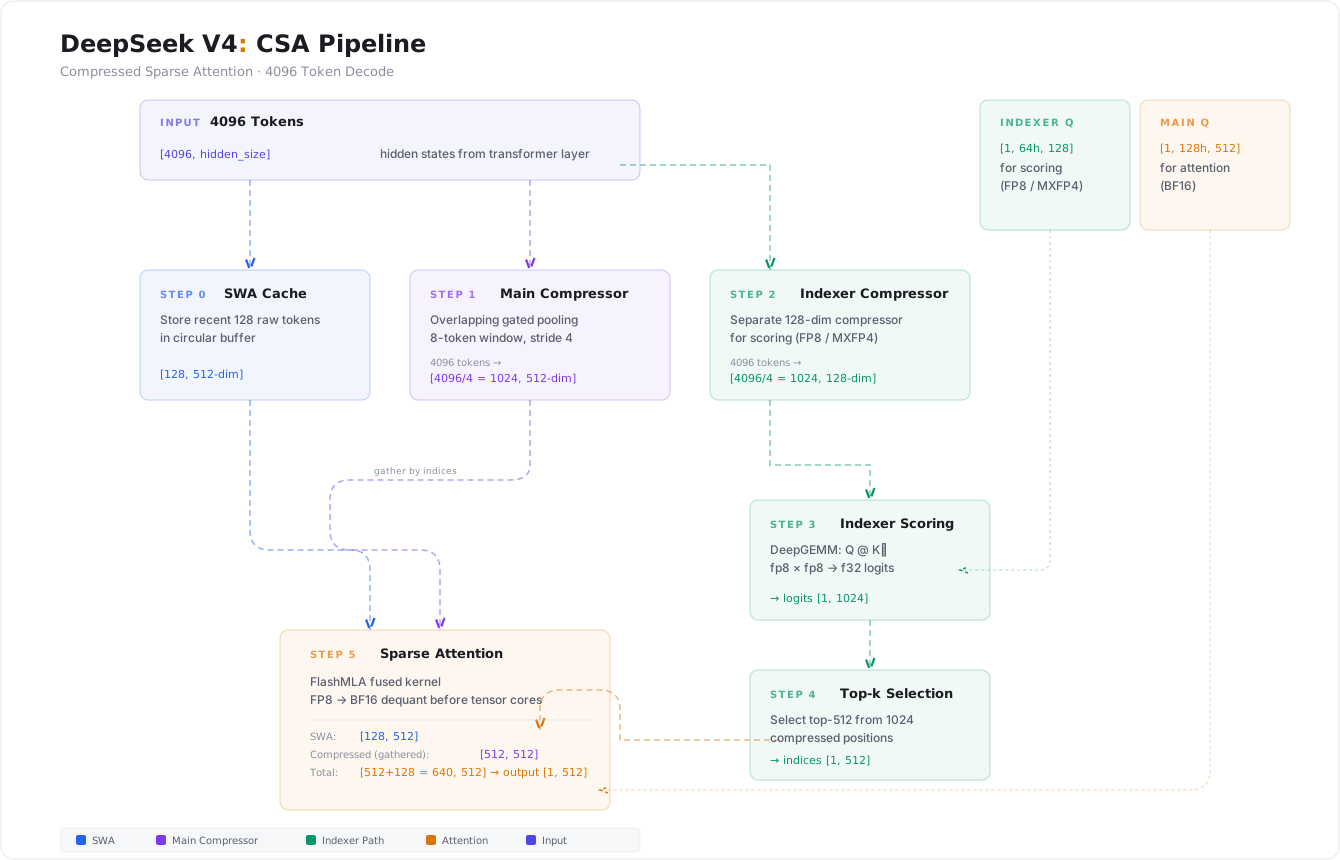
Step 0: SWA Cache
Store the most recent 128 raw tokens in a circular buffer.
→ [128, 512-dim]
Step 1: Main Compressor
Compress 4096 tokens into 1024 entries via overlapping gated pooling (8-token window with stride 4).
→ [4096 tokens] → [4096/4 = 1024, 512-dim] in main KV cache
Step 2: Indexer Compressor
A separate, smaller compressor produces 128-dim representations of the same compressed positions.
→ [4096 tokens] → [4096/4 = 1024, 128-dim] in indexer KV cache
Step 3: Indexer Scoring (DeepGEMM)
The indexer’s own query (64 heads × 128-dim — separate from the main
attention’s 128 heads × 512-dim) scores each compressed position via
fp8_fp4_mqa_logits:
→ Indexer_Q [1, 64h, 128] @ K [1024, 128]ᵀ → logits [1, 1024]
Low-bit FP8/FP4 operands go directly to tensor cores here. This is fine because only the ranking order matters — we’re picking top-k, not computing precise attention values.
Step 4: Top-k Selection
Select the 512 highest-scoring compressed positions.
→ logits [1, 1024] → indices [1, 512]
Step 5: Sparse Attention (FlashMLA)
Gather the selected 512 compressed entries from the main KV cache, combine with 128 SWA entries, and run fused attention via FlashMLA:
→ Main_Q [1, 128h, 512] × gathered_K [512+128 = 640, 512] → output [1, 512]
The FP8 KV cache is dequantized to BF16 before reaching the tensor cores. FlashMLA uses warpgroup specialization to overlap the dequant with MMA operations.
Design Insights
Why two Q projections? The main attention Q (128 heads × 512-dim = 65K parameters per token) needs full precision to compute accurate attention values. The indexer Q (64 heads × 128-dim = 8K parameters per token) only needs to rank positions. This 8× reduction in scoring dimensionality keeps the indexer fast enough to run every decode step.
Why C4A gets an indexer but C128A doesn’t? At 4:1 compression, 1M tokens produce 262K entries — far too many to attend to all. At 128:1, there are only 8K entries, which is cheaper to attend to than to score-and-select from.
Why the 128-token window is so small? The sliding window primarily exists to solve a causal gap with C128A: a compressed entry summarizing positions 0–127 would leak future information to queries at position 50. The 128-slot raw window ensures every query can access its local context without violating causality.
Why alternating C4A / C128A layers? V4 Pro alternates between fine-grained (4:1) and coarse (128:1) compressed attention every other layer. This gives the model both detailed and broad views of the context at every pair of layers — analogous to multi-scale feature pyramids in computer vision.
References
- vLLM blog: DeepSeek V4 support
- DeepSeek V4 Pro config
- DeepSeek V4 Flash config
- vLLM source:
vllm/model_executor/layers/deepseek_v4_attention.py,vllm/model_executor/layers/deepseek_compressor.py,vllm/model_executor/layers/sparse_attn_indexer.py